

Living with either colour vision deficiency (colourblindness) or autism spectrum disorder (ASD) brings its own set of daily challenges. But when the two overlap—as they often do—the world can feel even more confusing, unpredictable, and sometimes overwhelming. That’s because both conditions affect how someone interacts with the world around them, processes sensory information, and communicates with others.
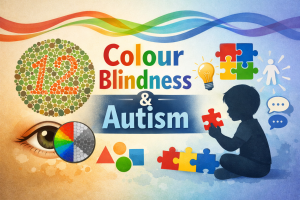
Colourblindness is a visual condition that affects how certain colours are perceived, most commonly red, green, or blue tones. Autism, on the other hand, is a developmental difference that can influence social interaction, communication, sensory sensitivity, and how a person experiences the world. While they are separate conditions, many people live with both—and understanding how they interact is an important step toward better support.
A Sensory Puzzle
Children and adults on the spectrum often have heightened or reduced sensitivity to sensory input. For some, colours may appear too bright or too dull, patterns too distracting, or lights too harsh. Add colour vision deficiency into the mix, and it becomes harder to navigate visual cues that others take for granted.
Imagine trying to understand a school timetable colour-coded by subject, or a traffic signal, or even reading a chart at the doctor’s office—without being able to clearly distinguish between the colours. For neurodivergent individuals who already rely heavily on routine and predictability, these visual challenges can create unnecessary anxiety or frustration.
Missed or Misunderstood
Unfortunately, because autism is often the focus of clinical care, colour vision differences can go unnoticed or dismissed. A child’s difficulty with visual tasks may be attributed to “behavioural” issues or assumed to be related solely to their autism, when in fact, they may also be struggling to see the colours correctly.
That’s why early, accurate testing is important. When we understand the full picture of how a child or adult processes the world—including how they see colour—we’re better placed to make practical changes that support them in everyday life.
Simple Tools, Real Impact
The iRo Lens testing kit offers a simple, non-invasive way to identify colour vision deficiencies from home. For individuals on the autism spectrum, the familiar and comfortable environment can make testing less stressful and more effective. There’s no need for a clinical visit or confusing instructions—just an accessible, straightforward way to understand how someone sees the world.
With clear results in hand, families, teachers, and carers can make thoughtful adjustments. This might include using textures, shapes, or words alongside colour codes, choosing more accessible clothing combinations, or modifying learning materials. These small changes can significantly reduce frustration and increase independence.
Understanding Builds Confidence
Living with both autism and colour vision deficiency doesn’t have to be a struggle—it simply requires a deeper understanding and the right tools. At Colour Vision Optical, we believe in meeting people where they are and giving them the information they need to thrive.
With the right insight and support, the world doesn’t have to be confusing. It can start to make sense—in all its shades.